Loading

Power conditioning
Holds output voltage within ±1% while the incoming supply swings, the difference between equipment that lasts and equipment that fails early.
Single & three phase · Air or oil cooled
How it corrects
Where it earns its keep
FAQ
A servo voltage stabilizer is an automatic voltage regulator that corrects variations in the incoming supply and delivers a controlled, steady voltage to the connected equipment. A servo motor positions a variable transformer to add or subtract voltage continuously, so the output stays within a tight band while the input keeps moving.
The output voltage is measured continuously and compared against a set point. When the two differ, the control circuit drives a servo motor that moves the wiper of a variable transformer, and a buck-boost winding adds or subtracts the difference. Because the correction is stepless, the output settles smoothly rather than jumping between fixed taps.
A relay-type stabilizer switches between fixed transformer taps, so its output moves in coarse steps and the load rides the error between them. A servo stabilizer corrects continuously through a motor-driven variac, holding a much tighter output band. For CNC drives, medical imaging and printing registration, that difference is the entire reason to buy one.
A static stabilizer corrects electronically with no moving parts, which makes it very fast. A servo stabilizer corrects mechanically through a motor-driven variac, which is slower but handles heavy overloads and unbalanced industrial loads robustly and costs considerably less at higher ratings. Which suits you depends on how fast your load needs correction and how rough your supply is.
Neither is better in general. They suit different duties. Air-cooled units are simpler to install and are typically chosen for lower and medium capacities in reasonably clean indoor locations. Oil-cooled units use insulating oil to carry heat away from the windings, which suits higher capacities, continuous duty and hotter or dustier rooms. Load, ambient conditions and duty cycle decide it.
Work from the connected load and the supply you actually have. Add up the equipment to be protected with realistic headroom, note whether it is single-phase or three-phase, measure how far your incoming voltage swings at its worst, and account for motor starting current. Those four things set the capacity, the phase configuration and the input window. Site conditions then decide air-cooled or oil-cooled.
Capacity is sized in kVA against the total connected load, with headroom for starting currents and any load you plan to add. Sizing tight to today's load leaves nothing for the inrush when a large motor starts, so a stabilizer chosen purely on the present running figure tends to be undersized in practice. Send us the equipment list and we will confirm the rating.
Yes, and on many sites it is worth doing. Generator output voltage moves as load steps on and off, particularly with large motor starting. Whether it is necessary depends on the alternator's own regulation, your load profile and how tight a band your equipment needs. Because we engineer both the genset and the stabilizer, we can size them together rather than bolting one onto the other afterwards.
The input window is selected to match how far your supply actually swings, and wider windows are available where the supply is severe. Correction is only possible within the specified window. A stabilizer chosen for a narrow range cannot rescue a supply that regularly falls outside it, so the worst-case measured voltage matters more than the average one.
Routine attention is modest: keep the unit clean and ventilated, check the carbon roller or wiper assembly and the variac surface periodically for wear, verify that protections still operate, and confirm the output is holding its set band. Oil-cooled units add oil level and condition checks. Our service team covers stabilizers alongside gensets on the same visit.
No, and it is worth being clear about that. A servo stabilizer corrects voltage variation. It is not a substitute for surge protection against lightning, for a UPS during an outage, or for correcting harmonics generated by your own drives. Optional protections (high and low voltage cut-off, overload, single-phasing, phase reversal) cover more ground, but the core job it does is voltage regulation.
Servo Voltage Stabilizers
Power conditioning
A servo stabilizer holds output voltage within ±1% while the incoming supply swings, the difference between equipment that lasts and equipment that fails early. Single-phase and three-phase, air-cooled and oil-cooled, specified to the input window your supply actually swings through.
1–5,000kVA
Capacity Range
±1%
Output Regulation
<20 ms
Response Time
A servo motor drives a variable transformer that corrects the output smoothly and continuously, unlike relay-type stabilizers, which switch between fixed taps in coarse steps and leave sensitive loads riding the error in between. For CNC drives, medical imaging and printing registration, that difference is the whole point.
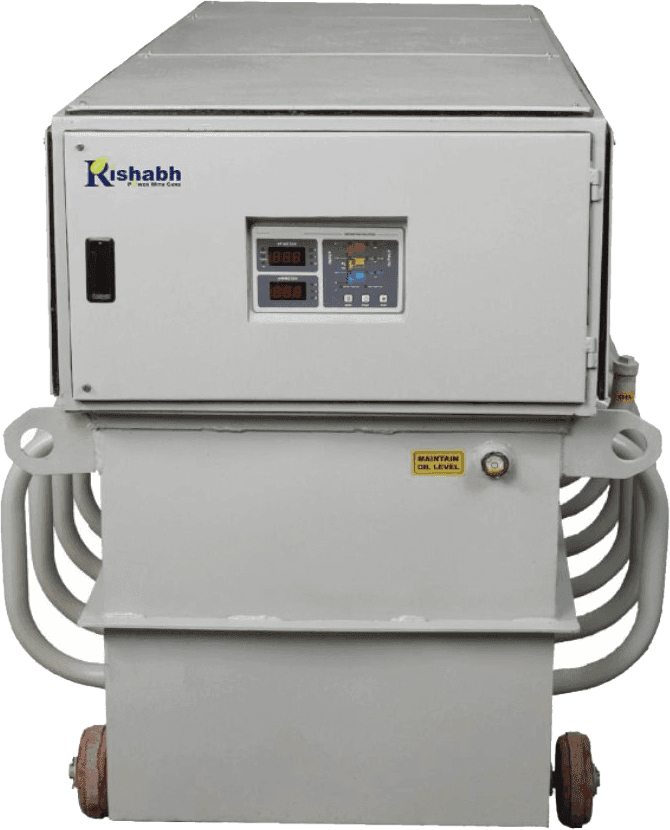
Single-phase units from 1 to 300 kVA and three-phase units from 10 to 5,000 kVA: air-cooled (AN) for indoor panels, oil-cooled (ONAN, IS:335 transformer oil) for higher ratings and harsher rooms. Input windows run as wide as 70–270 V single-phase and 150–460 V three-phase, with custom ranges and capacities built to order.
How it works
A servo stabilizer is a closed loop that never stops measuring. This is the whole mechanism, in the order it happens:
arrives high, low or swinging through the day
output is measured continuously against the set point
compares the two and decides which way to correct
drives the variac wiper, smoothly, not in steps
buck or boost winding adds or subtracts voltage
held within ±1% while the input keeps moving
The word that matters in that list is stepless. A relay-type stabilizer jumps between fixed taps and leaves your load riding the error in between. The servo loop closes that gap smoothly, which is why it suits equipment that reacts badly to a sudden voltage jump.
Technical specifications
Output voltage
220 / 230 / 240 V (±1%)
Input windows
70–270 V · 90–270 V · 140–270 V · 160–270 V
Frequency
50 / 60 Hz ±5%
Capacity
1–300 kVA (custom on request)
Output voltage
380 / 400 / 415 V (±1%) phase-to-phase
Input windows
150–460 V to 340–460 V phase-to-phase
Supply & loads
100% unbalanced supply and loads
Capacity
10–5,000 kVA (custom on request)
±1%
Output regulation, stepless copper-wound variac
< 20 ms
Response time · 10–60 V/sec correction rate
>96%
Efficiency · continuous 24-hour duty
−15 to +50 °C
Operating range · negligible waveform distortion
Built to IS:9815 and IS:2026, routine- and type-tested to IS:1180 with NABL-accredited lab type tests. Third-party inspection available on request. Optional protections: high/low voltage cut-off, overload cut-off, single-phase preventer, phase sequence and reversal protection, bypass provision, short circuit, earth fault, and surge & spike protection.
Where it earns its keep
registration drift stops at stable voltage
consistent motor speed, fewer thread breaks
protects drives and servo controllers
imaging equipment needs tight tolerance
compressors survive brown-outs
continuous duty at remote sites
Pairing a stabilizer with a genset? Voltage stability matters on generator supply too. Ask about combined sizing when you size your generator.
Questions